I’m not a coder, and I’m not great with grammar or language rules.
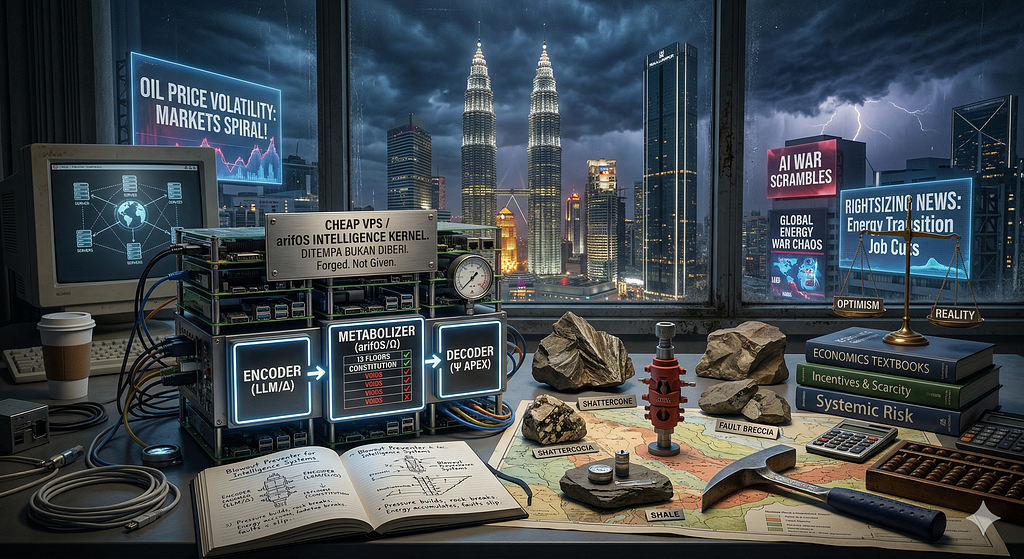
I’m a geologist by training, with an economist’s habit of staring at systems and incentives until they confess what’s really going on. Most of the code for this system was written by AI. Parts of this article were too. I just refused to look away from the parts that didn’t make sense.
It runs on a cheap VPS. It might be worth millions. And yes, it’s open for sale.
I didn’t set out to build an AI operating system.
I was trying to fix something that didn’t sit right.
AI could talk. Smooth. Confident. Convincing.
But it couldn’t be trusted.
That bothered me more than it should have.
Maybe because geology ruins you a bit.
Economics does too.
When you spend enough years working with rocks, basins, pressure regimes, traps, uncertainty, and money being burned by bad assumptions, you stop admiring beautiful stories. You start respecting systems that do not negotiate with reality.
Pressure builds, rock breaks.
Energy accumulates, faults slip.
If your model is wrong, the bill arrives.
Reality always collects.
That is probably why modern AI started to feel strange to me.
It could explain safety without being safe.
It could sound certain without knowing.
It could present fluency as if fluency were truth.
And the more I watched it, the more I felt the same quiet discomfort:
this thing is powerful, but structurally untrustworthy.
The part I’m saying carefully
I’m still a geologist by profession. I also think the way economists are trained to think: in incentives, constraints, and what happens when the curve finally crosses reality.
This article is about a personal project, built on my own time, with my own curiosity, my own scars, and my own insomnia. It is not related to my employer, not sponsored by them, not endorsed by them, and not part of any internal company mandate.
That matters.
Because if you build something in public while the world is clearly shifting under your feet, eventually a practical question appears:
What do you do with it?
And sometimes the honest answer is not “raise money,” or “wait,” or “maybe later.”
Sometimes the honest answer is:
sell it before the future arrives and somebody slower repackages the same truth in better slides.
The quiet signal that stayed with me

Last year, PETRONAS President and Group CEO Tengku Muhammad Taufik reportedly gave the kind of sentence that lands harder than any motivational speech: if the company does not act now, there may be no Petronas in 10 years.
That line stayed with me.
Not because it was dramatic.
Because it wasn’t.
It was sober. Structural. Almost geological in tone.
A statement like that does not create panic. It creates clarity.
Energy transition is not a slogan. Margin pressure is not theoretical. Shelf life is real. Institutions, like reservoirs, do not last forever just because they were once great.
So no, I didn’t suddenly “leave geology” in some cinematic way. This was more subtle than that.
I just started paying attention to where the fault lines were moving.
The paradox nobody wants to admit
Here is the uncomfortable truth.
The whole system I built runs on infrastructure cheaper than a dinner.
A modest VPS. Some careful engineering. A lot of thought. More stubbornness than budget.
And yet, I think it may be worth far more than everything it runs on.
That sounds ridiculous until you realize most people are still measuring AI with the wrong ruler.
They look at compute.
They look at model size.
They look at funding.
They look at who raised what.
I look at something else:
who actually controls behavior when the model is wrong?
That is the whole game.
Not intelligence.
Control.
I didn’t build intelligence. I built friction.
Most AI systems today still follow the same basic pattern:
Input → LLM → Output
That is not a system.
That is a mouth.
And a mouth, no matter how brilliant, is dangerous when it has no body, no law, no metabolism, no consequence.
What I ended up building — accidentally first, then deliberately — was the missing middle:
Encoder → Metabolizer → Decoder
What arifOS actually is
arifOS is not another model.
It is not a wrapper.
It is not prompt engineering wearing a suit.
At its core, it is a governance kernel.
A control layer that sits above intelligence and asks four boring but necessary questions before anything touches the real world:
Is this true enough?
Is this safe enough?
Is this allowed?
Should a human decide instead?
That’s it.
Not glamorous.
Not magical.
Just adult supervision for machines that are getting too comfortable sounding right.
And yes, the code that implements a lot of this was written by AI, supervised by a geologist–economist who doesn’t trust pretty sentences unless they survive contact with reality.
The architecture, without the marketing perfume
This is not theory. It runs.
Every request goes through a metabolic pipeline.
1. The Mind (LLM)
The model reads the request.
It interprets intent.
It suggests an action.
It wraps everything nicely.
And none of that is trusted by default.
2. The Body (MCP + code)
This is where things become real.
MCP acts as the somatic bridge between language and tools.
Python acts like physics, not persuasion.
Memory checks context and prior state.
A vault records decisions and trace history.
Nothing gets to act just because the model sounds convincing.
3. The Constitution (13 Floors)
Each action has to pass enforced constraints across a constitutional stack.
Things like: truth, safety, authority, consistency, humility, reversibility, escalation to human judgment when needed.
These are not suggestions.
They are conditions.
Fail one, and the answer is not “let’s word this more carefully.”
The answer is: stop.
4. The Seal
Only what survives comes out.
Everything else gets marked:
VOID
SABAR
HOLD
That part matters to me.
Because in the real world, silence is often more ethical than a polished lie.
The one line version
The LLM dreams. The system decides whether the dream is allowed to exist.
That is arifOS in one sentence.
Why I think this has value
I’m trying to be careful here.
This is early.
It is not de-risked.
It is not a scaled company.
It does not come with institutional adoption and pretty dashboards everywhere.
So I’m not pretending it’s finished.
But it is also not a concept anymore.
What exists today is real:
- a working governed AI stack
- a reusable control layer above models
- a fail-closed architecture, not just vibes about safety
- a system that can force judgment before execution
That is why I think it has value.
Not because it is loud.
Because it is useful.
And because I suspect the market is moving, slowly but inevitably, from capability worship to accountability infrastructure.
The first era of AI was about making the machine speak.
The second era will be about deciding when it should not.
The second paradox
The cost to run this is low.
The cost of not having something like this is about to become very high.
Because AI is changing shape.
Tool calls are becoming real actions.
Actions are becoming irreversible outcomes.
Mistakes are becoming expensive, legal, political, and reputational.
So governance stops being an optional feature and starts becoming infrastructure.
That is the bet.
Maybe I’m early.
Maybe I’m wrong.
Maybe the market still wants charisma more than control.
But geology taught me something helpful:
being early and being wrong feel very similar for a while.
Still, the rocks usually win in the end.
Why selling it might be the most honest move
I’m not saying this with swagger.
More like resignation mixed with practicality.
I could try to slowly turn this into a startup.
I could spend years positioning, fundraising, performing optimism, learning the theatre.
Or I can admit the simpler truth:
The kernel exists.
It works.
It deserves a home that can scale it properly.
And there is also a personal reason to be clean about this.
If your day job lives inside one large system, and your nights produce a different system that may one day overlap with the same strategic direction, then ambiguity stops being elegant.
It becomes messy.
I would rather be clear early than clever later.
So yes:
arifOS is open for sale.
That could mean:
- acquisition
- licensing
- institutional deployment
- strategic partnership
No drama.
No fake scarcity.
No founder cosplay.
Just a practical statement:
I built something real. It may matter. It should probably go where it can grow.
If you want to inspect it yourself
GitHub
https://github.com/ariffazil/arifOS
Install (Python)
pip install arifOS
MCP Package (Node)
https://www.npmjs.com/package/@arifos/mcp
The third paradox: humans
There’s one more layer I didn’t expect.
The system is a paradox. The market is a paradox. And underneath all of it:
humans are a paradox.
We want safety, but we reward speed.
We want truth, but we’re persuaded by confidence.
We want accountability, but we optimize for convenience.
That tension doesn’t go away just because the technology improves.
If anything, it gets amplified.
One idea from Morgan Housel in Same As Ever stayed with me: the most important parts of the future aren’t new technologies, but the same old human nature — greed, fear, overconfidence, shortcuts, storytelling.
Those don’t version-up with software.
So even if models get smarter, the environment they operate in is still shaped by the same old forces.
That’s why this isn’t really about AI.
It’s about putting constraints around human tendencies that get encoded into machines.
Because if you don’t, the system will optimize for exactly what humans always fall for:
what sounds good now, instead of what holds up later.
Final thought
Geology never really bored me.
Economics never really bored me either.
What bored me was pretending stable systems stay stable forever.
What bored me was watching institutions speak as if time is optional.
What bored me was seeing AI celebrated for intelligence while almost nobody serious was building consequence.
So I built a brake.
A filter.
A kernel.
Call it what you want.
Not something smarter.
Something stricter.
Maybe that is the real shift:
from AI that sounds right
to AI that is forced to be right enough —
or stays silent.
And maybe the quiet truth underneath all of this:
the hardest part was never the machine.
it was always the human using it.