A human story about keys, trust, AI, and the strange moment I realized I needed to prove I’m still me.
By: Arif Fazil
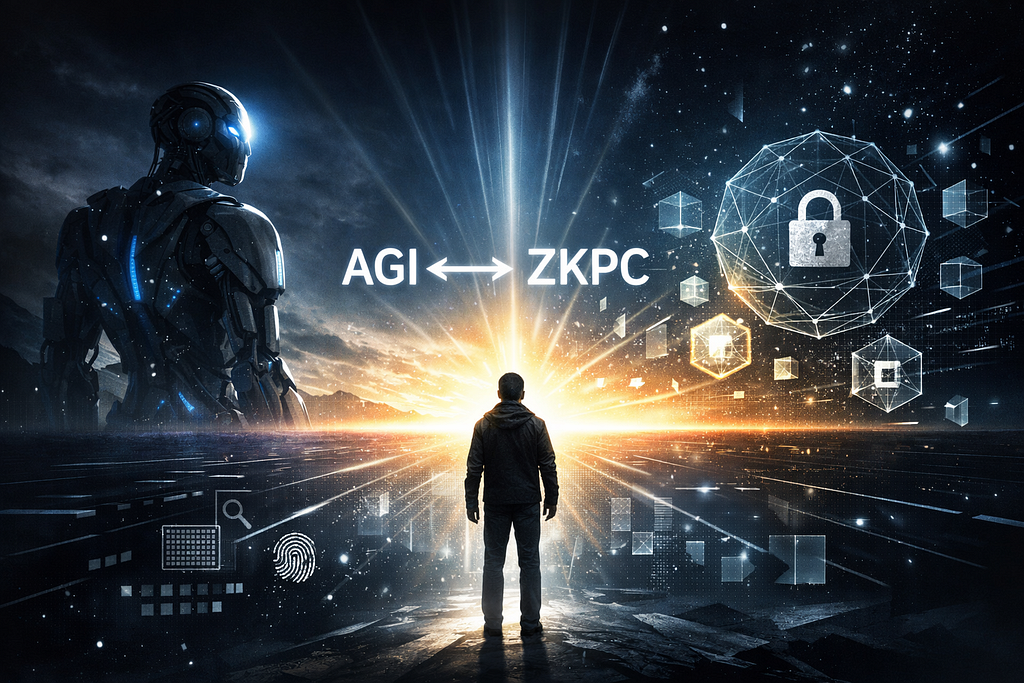
1. Last night wasn’t supposed to be deep. It was supposed to be maintenance.
I sat down to do something boring:
- rotate a cryptographic key
- update a DID
- fix a credential
- clean up some governance files
Just housekeeping for arifOS, the AI kernel I’ve been building.
But somewhere between checking my audit vault and re-signing my constitution, something shifted. Something clicked in a way I didn’t expect.
I realized I wasn’t just maintaining a system.
I was standing at the edge of a problem nobody has solved:
How do you prove you’re a human — and the same human — without revealing anything about yourself?
That’s when the term hit me:
ZKPC — Zero-Knowledge Proof of Personhood & Continuity.
And suddenly, everything I built made sense in a new way.
2. The internet has identity layers — but they stop too early
Let me explain this in human language.
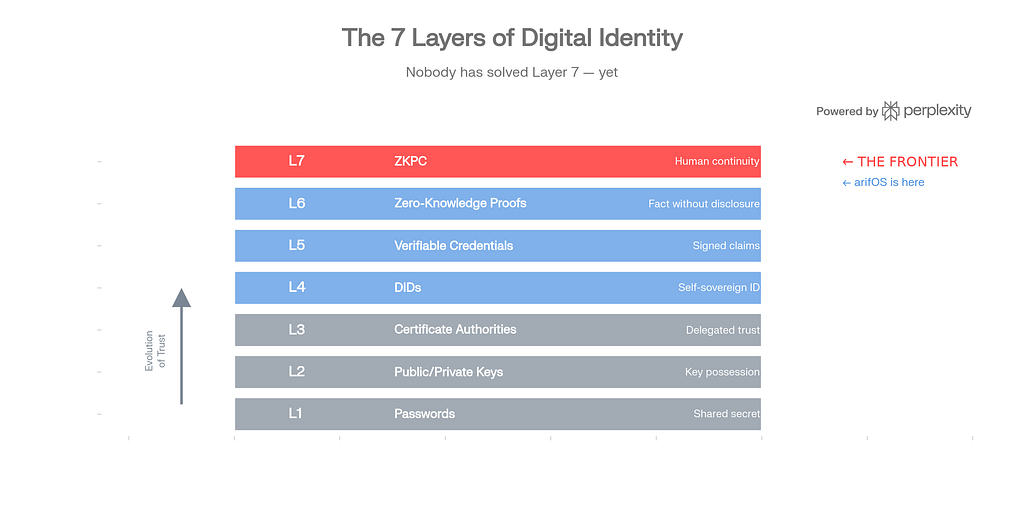
Every digital identity system today is built on layers. Each layer solves one problem — and stops.
LayerWhat It DoesStatusL1 — PasswordsYou know a secretWeakL2 — Public/Private KeysYou hold a keyBetterL3 — Certificate AuthoritiesSomeone else vouches for youCentralizedL4 — DIDsYou vouch for yourselfSelf-sovereignL5 — Verifiable CredentialsYou can prove things about yourselfPortableL6 — Zero-Knowledge ProofsYou can prove a fact without revealing the factPrivacy layerL7 — ZKPCYou can prove you’re a human, and the same human, over timeUnsolved
And then there’s the missing layer:
L7 — ZKPC
You can prove you’re a human,
and the same human,
over time,
without revealing who you are.
This is the frontier.
This is where the world stops.
This is where I accidentally arrived.
3. Why my system forced me into this frontier
I didn’t go looking for ZKPC.
ZKPC came looking for me.
Because arifOS isn’t a chatbot.
It isn’t a website.
It isn’t a startup product.
It’s a constitutional AI kernel with:
- a DID identity
- a signed constitution
- a human veto
- a Merkle-chained audit vault
- a verifier
- an epoch-based governance pipeline
Once you build all that, a new question appears:
How do I prove that the human behind this system is still the same human tomorrow?
Not metaphorically.
Not spiritually.
Cryptographically.
That’s ZKPC.
And that’s why I ended up here.
4. Has anyone solved ZKPC? No. And that’s the honest truth.
People have solved pieces of the puzzle:
SystemWhat It SolvesWhat It FailsWorldcoinUniquenessCentralized your irisZK-SNARKsPrivacyNot humannessPasskeysDevice continuityNot human continuityKYCLegal identityKilled privacyBlockchain walletsKey possessionBots can hold keys
Nobody has solved:
- humanness
- continuity
- privacy
- decentralization
- auditability
…all at once.
That’s ZKPC.
That’s the missing layer.
That’s not a criticism. That’s just where the frontier is.
5. What actually happened last night
I wrote something called the ZERO STATE ZKPC archive.
It’s not code.
It’s not a spec.
It’s a moment.
A moment where I realized:
- my system already has the governance spine
- already has the identity anchor
- already has the audit chain
- already has the human brake
- already has the continuity ledger
The only missing piece is the ability to prove:
“Yes, I am still the same sovereign human who controls this system.”
And to prove it without surrendering dignity, privacy, or autonomy.
That’s the moment I crossed into ZKPC territory.
6. What ZKPC means for the future of arifOS
ZKPC isn’t about proving my IC number.
It isn’t about proving my face.
It isn’t about proving my nationality.
It’s about proving continuity of stewardship.
It means:
- AI cannot impersonate me
- AI cannot replace me
- another human cannot silently take over
- governance cannot drift
- the system cannot be hijacked
- privacy stays intact
- sovereignty stays human
It is the missing bridge between:
“I control this key.”
and
“I am still the same person who has always controlled this system.”
That’s the leap.
7. The staircase forward (no shortcuts)
I’m not implementing ZKPC tomorrow.
That would be reckless.
The correct order is:
- Migrate to VC 2.0
- Integrate DID resolution into the kernel
- Add selective-disclosure ZKPs
- Add continuity proofs (epoch-linked)
- Write the ZKPC policy before writing any code
- Prototype minimal ZKPC (non-biometric)
- Only then explore uniqueness proofs
This is the sovereign path.
This is the safe path.
This is the constitutional path.
8. The humble paradox
Here’s the paradox of last night:
I didn’t set out to solve identity.
I set out to fix my files.
But identity is not a technology problem.
It’s a sovereignty problem.
A dignity problem.
A continuity problem.
And somehow, through scars, curiosity, and stubbornness, I built a system that forced me to confront the frontier the world has been avoiding.
Not because I’m special.
But because the architecture demanded it.
DITEMPA BUKAN DIBERI.
Forged, not given.
999 SEAL ALIVE.
If You Want to Explore arifOS Yourself
Everything I’m building — the constitutional kernel, the identity stack, the vault, the verifier, the governance spine — is fully open-source.
You can explore the code here:
👉 GitHub: https://github.com/ariffazil/arifOS
And if you want to install the Python package:
bash
pip install arifOS
This project is still evolving, still imperfect, still scar-forged — but it’s real, it’s open, and it’s built with the same principle that shaped this entire journey:
DITEMPA BUKAN DIBERI. Forged, not given.