— So I Built arifOS
By Arif Fazil
I did not build arifOS because I wanted another AI product. I built it because the agent era is already here, and too much of it feels like handing sharp tools to systems that are fluent, fast, and insufficiently governed.
OpenClaw, Hermes Agent, and the wider agentic stack make one thing clear: we have moved past chatbots into software that can call tools, keep memory, interact with external systems, and take multi‑step actions on our behalf. That is powerful, but it creates a simple engineering problem that too many people still treat like branding: once an agent can act, trust is no longer a vibe, it becomes a systems question.
Why trust is the real problem
In geology, uncertainty is not a bug. It is the terrain. A seismic line is not the Earth. A well log is not the whole basin. A map is not the reservoir. Every interpretation carries risk, and overconfidence gets punished by reality.
That habit stayed with me when I moved deeper into AI systems. Today, many agent frameworks optimize for speed, capability, and autonomy, while governance is still treated as a wrapper, a prompt trick, or a policy PDF sitting outside runtime.mckinsey+2
That is why arifOS exists.
Not as AGI theatre. Not as another chatbot shell. Not as a claim that the model has become a being.
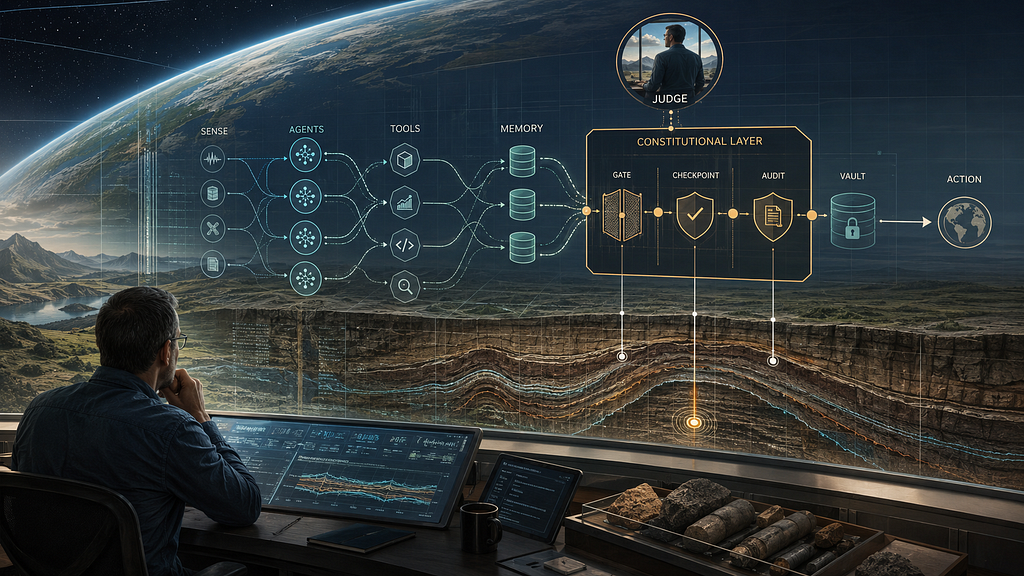
arifOS is a constitutional control room for AI agents. It is a governed operating layer that lets agents observe, retrieve, remember, reason, critique, and act only inside a process shaped by evidence, restraint, audit, and human judgment.
The moment we are in
The current generation of agents is qualitatively different from ordinary chatbots. Agentic systems can plan across multiple steps, call tools, store and retrieve memory, and interact with other agents and external systems on behalf of humans.
That is why governance can no longer be optional. In 2026, Singapore’s Model AI Governance Framework for Agentic AI explicitly warns that autonomous agents raise new risks because they can access sensitive data, modify their environments, and create unpredictable outcomes across multi‑step and multi‑agent workflows. It highlights concrete failure modes: erroneous actions, unauthorized actions, data leakage, and cascading failures across interconnected tools and systems.
Surveys mirror this discomfort: only a minority of people actually trust AI to act autonomously for them, and most want clear human approval points and override mechanisms. The technology is sprinting towards autonomy, but users are still asking, “Who is really in control?”
This is why I say I have trust issues with AI agents. Not emotional trust issues. Architectural trust issues.
Where arifOS fits in the agentic stack
Think of the current agent stack in three layers.
First, you have agent frameworks: Hermes Agent, OpenClaw, LangGraph, CrewAI, and others. Second, you have tools and services: MCP servers, APIs, databases, browsers, workflows, code runners. Third, you have governance and memory: policies, audit, human approvals, institutional context.
Most frameworks today focus on the first two layers. Hermes is framed around self‑improving agents and dynamic memory. OpenClaw is often discussed as a strong self‑hosted orchestrator with wide tool integration and an ecosystem‑first design. These are real advances, but they sharpen the same question: who governs how these agents use memory, tools, and authority over time, across people and systems?
That is where arifOS sits.
arifOS is not trying to out‑hype the agent frameworks. It is trying to provide the constitutional substrate beneath them.
If a framework gives agents hands, arifOS asks when those hands must stay still. If a framework gives agents memory, arifOS asks which memories are valid, private, contradicted, stale, or too consequential to use casually. If a framework gives agents autonomy, arifOS asks where human checkpoints must remain non‑negotiable.
A normal MCP server says: here are tools the AI can call. arifOS says: here are tools the AI can call, but only inside a governed process with memory
rules, evidence rules, and judgment rules.
MCP gives access. arifOS gives constraint.
What arifOS actually is
arifOS is not a single agent. It is a governed MCP stack arranged like an intelligence process.
It has organs that mirror how we would want a careful human to think:
SENSE observes the world. FETCH gathers evidence. MIND reasons through the question. KERNEL routes the task. MEMORY recalls or stores governed memory. HEART critiques risk, dignity, and human impact. OPS measures system health and cost. JUDGE produces a verdict. VAULT seals important outcomes into an audit trail. FORGE executes builds or changes only under supervision.
The names sound dramatic because they are human architecture, not just software modules. The purpose is simple: do not let a model jump directly from prompt to action.
Make it pass through observation, evidence, memory, critique, judgment, and audit.
That is the operating instinct inside arifOS.
The geological instinct inside the machine
In exploration, nobody serious drills just because one bright amplitude looks exciting. The discipline is to ask what supports the interpretation, what contradicts it, and what would prove it wrong.
The same discipline should exist in agent systems.
A normal agent loop says: this looks relevant, I will proceed.
arifOS tries to interrupt that jump.
Relevant according to what? Which evidence? Was that memory contradicted? Is it stale? Is it private? Is the action reversible? Does a human need to approve this?
That is the geologist in me refusing to let fluency impersonate judgment.
Memory is not the same as wisdom
Most AI memory today still looks like this: put text into a vector database, retrieve similar text later.
Useful, yes. Sufficient, no.
Similarity is not truth. Relevance is not authorization. Memory is not judgment.
The agent era makes this more dangerous, not less. The more capable agents become, the more dangerous it is to treat raw retrieval as if it were governed memory.
That is why arifOS uses tiers of memory. Some memories are temporary. Some are session‑level. Some become canonical. Some are sacred, not in a mystical sense but in a high‑consequence sense.
A painful correction, a major human decision, a safety boundary, a serious institutional lesson: these should not be treated like ordinary notes.
Phoenix‑72 and the discipline of cooling
One design principle inside arifOS matters deeply to me: not every painful event should be converted into permanent law immediately.
Humans know this pattern. Something goes wrong and the instinct is to overfit the wound.
Never trust this. Never do that again. This proves everything.
But pain can distort judgment. So arifOS uses a cooling concept I call Phoenix‑72. Certain memories must cool before they become canon.
Time passes. Utility is tested. Witnesses matter. The wound is preserved as consequence, but it is not allowed to become sovereign too quickly.
The line that guides me is simple: memory must preserve consequence without worshipping the wound.
Forgetting is not failure
A serious intelligence system must know what to forget.
Forget noise. Forget stale facts. Forget unsupported inference. Forget duplicates. Forget exaggeration.
But never erase accountability.
That is the paradox. A system that forgets everything has no continuity. A system that forgets nothing becomes rigid and haunted.
So arifOS treats forgetting as transmutation, not erasure. A memory can be downgraded, superseded, archived, or marked stale, while the audit trail remains intact.
The human stays the judge
This is not a branding line. It is an engineering requirement.
The model is not a person. It has no soul, no rights, no lived experience, and no final authority.
It is an instrument.
The agent may retrieve, reason, critique, suggest, and warn. But it must not self‑authorize consequential action.
This boundary is increasingly reflected in mainstream governance guidance. The agentic AI framework from IMDA stresses meaningful human accountability, checkpoints for approval, and special care around high‑stakes or irreversible actions. Other guidance on agent governance echoes the same idea: trust depends on transparency, override, traceability, and embedded oversight rather than after‑the‑fact apologies.ibm+3
In arifOS, this boundary appears in the JUDGE layer and in explicit human approval gates.
The human remains sovereign.
Why this matters now
The future of AI is not just chat. It is agents that can affect code, documents, workflows, infrastructure, money, and eventually physical systems.mckinsey+1
That means the old question “can the model answer?” is no longer enough.
The more important questions are: should it act, on what evidence, under whose authority, with what audit trail, and with what fallback if it is wrong?
That is the gap I wanted to build for.
Not bigger models. Not louder claims. A better container.
arifOS and the ZKPC seal
I also believe more systems need a stronger notion of sealing. Not just logging, but structural ways to prove that something happened the right way.
In cryptography, a zero‑knowledge proof lets one party prove a statement is true without revealing the underlying data. The deeper insight matters beyond blockchain: verification and disclosure do not always have to be the same thing.
That is the spirit behind what I call a ZKPC seal in arifOS.
It is not a claim that there is a full production zk‑SNARK pipeline in place today. It is a design direction.
The idea is that important agent outcomes should eventually be sealable in a way that proves a governed process was followed, checkpoints were passed, the verdict was issued under the right authority, and the record was not silently tampered with, without dumping every sensitive input into public view.chain+1
In plain language: prove the path was lawful without exposing everything that flows through it.
That is what I mean by seal.
For geology, and beyond geology
I come from geology, so I keep returning to the Earth.
Geoscience institutions are full of lost memory. Old wells are forgotten. Dry‑hole lessons disappear. Assumptions get buried in slide decks. People leave, and judgment leaks out of the organization even when files remain.
A governed AI memory system for geology should not just store reports. It should preserve why a prospect was matured, what risk was accepted, what uncertainty was known, which analogy failed later, and what should not be repeated.
The same need exists in engineering, finance, healthcare, and government, where agents increasingly touch workflows that require evidence, permissions, and accountability.kore+2
What exists today
arifOS is early. It is not a polished SaaS. It is not something I want to oversell.
But it is real enough to test. The public repository describes arifOS as a constitutional MCP kernel for governed AI execution, using an AAA architecture: Architect, Auditor, Agent.
The current direction includes an MCP‑native tool surface, a constitutional kernel, governed memory, vector recall, database‑backed records, contradiction handling, cooling before canonization, human approval gates, and domain modules such as GEOX, WELL, and WEALTH.
Some parts are working. Some are partial. Some are aspirational.
That distinction matters.
Build your own frame
My view is simple: more people should build personal and institutional AI kernels.
Not to imitate souls. Not to worship agents. Not to outsource conscience.
Build systems that remember your evidence rules, your approval boundaries, your domain workflows, your risk tolerances, and your audit discipline.
The exact constitution does not have to be mine.
But agents should not run naked.
They need a frame.
Closing
I built arifOS because I do not trust unguided autonomy.
I do not want intelligence without accountability.
I do not want memory without forgetting.
I do not want fluent systems mistaken for truthful ones.
I do not want agents touching the world without audit.
The Earth taught me something simple: hidden systems require humility. Confidence is cheap. Reality is not.
AI should be treated the same way.
Observe carefully.
Cite evidence.
Respect uncertainty.
Preserve memory.
Forget wisely.
Escalate consequence.
Let the human judge.
Seal the record.
That is arifOS.
Not given.
Forged.
pip install arifOS
GitHub: https://github.com/ariffazil/arifos
DITEMPA BUKAN DIBERI — 999 SEAL ALIVE