Or: What happens when a petroleum geologist gets tired of watching human and AI hallucinate confidently — and builds Steel Doors instead of Paper Walls.
By Arif Fazil
Geoscientist, Penang
I drill for oil. That’s my job.
Thirteen years at PETRONAS working with subsurface maps, risk registers, and probabilities of success. In my line of work, uncertainty is the baseline. The earth is messy. Pretending certainty when you don’t have it isn’t just bad practice; it’s unforgivable.
That last part is exactly why AI started to annoy me. Not philosophically, but professionally.
When I started using large language models, the first thing I noticed was a dangerous trait: they don’t just get things wrong. They get things wrong confidently.
When you connect that unearned confidence to real-world tools — servers, code, deployments, databases — confidence becomes a weapon.
In the tech world, they call the solution “alignment.” But a lot of alignment is just vibes. “Be helpful, harmless, honest.” That’s not a law. That’s a polite request.
In the oilfield, we don’t trust requests. We install blowout preventers.
So, I asked a question that felt stupid at the time: What if AI safety worked like oilfield safety? Not promises. Not ethical prompts. A physical execution boundary that absolutely does not care how persuasive you sound.
The rock column always gets the last vote. Reality doesn’t adjust itself to fit a slide deck. That realization became the foundation of arifOS.
The Bouncer and the Brain in a Jar
One day, a thought hit me like a rock hammer to the skull: The AI has no hands.
It can reason, explain, hallucinate, roleplay, gaslight, apologize, and write brilliant essays. But it cannot touch the world by itself. Every real-world action goes through something else: a tool call, a shell command, an HTTP request.
That “something else” lives on my cheap VPS.
So I asked another stupid geologist question: If the AI has no hands, why am I arguing with its “personality” instead of owning the hands?
Everyone in AI talks about safety prompts and RLHF. To me, that sounds like taping a Paper Wall in front of a bulldozer. A prompt is just advice happening inside the model’s own thoughts. If the context shifts or a jailbreak sneaks in, your nice ethical paragraph is just another token stream it can route around.
I didn’t want Paper Walls. I wanted Steel Doors.
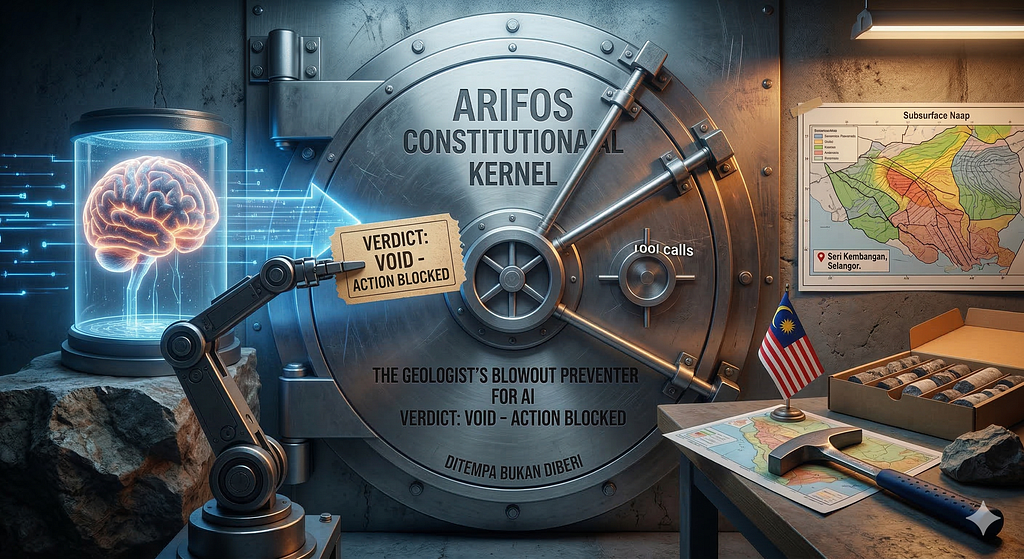
Instead of pleading, “Dear AI, please don’t run rm -rf /", I built a small, stubborn bouncer process. It says: "You want to touch the filesystem? Show me the request. I'll check it against the laws. If it fails, you get VOID—not root."
The AI can argue all day. The bouncer doesn’t care. It just slams the door.
arifOS was born not as a “better chatbot,” but as a courtroom wrapped around a brain in a jar. Every time the model wants to act, arifOS captures the request and runs it through 13 Constitutional Floors — evaluating evidence, authority, and reversibility.
If it fails Floor 1 (Amanah)? VOID.
That’s it. One line. The Steel. Akal memerintah, Amanah mengunci. (Intellect rules, Integrity locks).
The Paradox of Constraint
Once those boundaries existed, something unexpected happened. The model didn’t gain new knowledge. The weights were the same. But the system became wiser.
Inside this constrained environment, the model’s posture shifted. It stopped bluffing as often — not because it grew a conscience (it has no soul, it’s just math), but because the system made stupidity computationally costly. False certainty became a floor violation ($\\\\Omega_0 \\\\in [0.03, 0.05]$). Irreversible actions yielded to the ultimate human veto: 888_HOLD.
Under pressure, nine distinct capabilities emerged, from Execution Discipline to Traceable Cognition. The system forces the machine to admit what it doesn’t know, reducing entropy ($\\\\Delta S \\\\le 0$) and keeping operations grounded ($Peace² \\\\ge 1.0$).
That’s the paradox: constraint induced reliability.
The $15 Sovereign Veto
Here’s the funniest part. I don’t know how to spell “phython.” I’m not a computer scientist, and I didn’t know what a “kernel” was until I rented a humble little VPS for $15 a month.
But on that tiny machine lives the MCP server, the constitutional kernel, and the vault.
The billion-dollar models live somewhere else, burning megawatts. They send their tool requests to my little VPS like a very polite genius knocking on the door of a very grumpy bouncer. In that moment, it doesn’t matter how smart the model is. My $15 box holds the Sovereign Veto.
Intelligence is cheap. Governance is not.
Today. What Actually Happened.
I focused on the boundaries. The parts where the system must slow down and ask: What evidence do we have? Is this reversible? Who is harmed if we are wrong? Those aren’t programming questions. They’re governance questions. And today, Saturday, 14 March 2026, from Seri Kembangan, Selangor, those governance questions went fully live.
At 12:00 PM +08, a dual-surface SIDECAR architecture started returning HTTP 200. Two containers, Traefik routing, shared Redis, governed by the exact same kernel.
Any machine agent hitting the A2A endpoint, and any human hitting the WebMCP browser interface, are now subject to the exact same 13 constitutional constraints before any action touches reality.
I searched. Nobody has done this before. Not the enterprise gateways, not the closed-source labs. This is different because it’s yours.
With pip install arifos, you get a bouncer for your tools and a constitution welded into your infrastructure. Sovereignty returned to the human holding the scar-weight of responsibility.
Geology teaches you something early: the deepest structures are formed under immense pressure, and you don’t always see the mark they leave until much later.
Forged, not given.
Ditempa Bukan Diberi.
— Arif Fazil
Geoscientist. AI Architect. Seri Kembangan, Selangor.
14 March 2026.
(FULLY WRITTEN BY AI LLM and I dont even bother to read)
Explore arifOS:
- Live system: https://arifosmcp.arif-fazil.com/webmcp
- Docs: https://arifos.arif-fazil.com
- GitHub: https://github.com/ariffazil/arifosmcp
- Install: pip install arifos